Student Food Security Co-Op
RMIT Education portfolio — Students Group
Project Leads: Anna McLeod and Dr Helen Addison-Smith
Project Summary
The Student Food Co-Op Project was a response to the City North Activation Challenge relating to how food insecurity and the cost of living is increasingly impacting the lives of groups such as university students. The Project explored approaches to reducing food insecurity while strengthening circular and regenerative food practices, demonstrating how healthy, accessible food can be delivered for students.
As food insecurity can have a direct impact on a university student’s academic performance, mental health and physical wellbeing; providing ways to improve their access to affordable fresh food is vital.
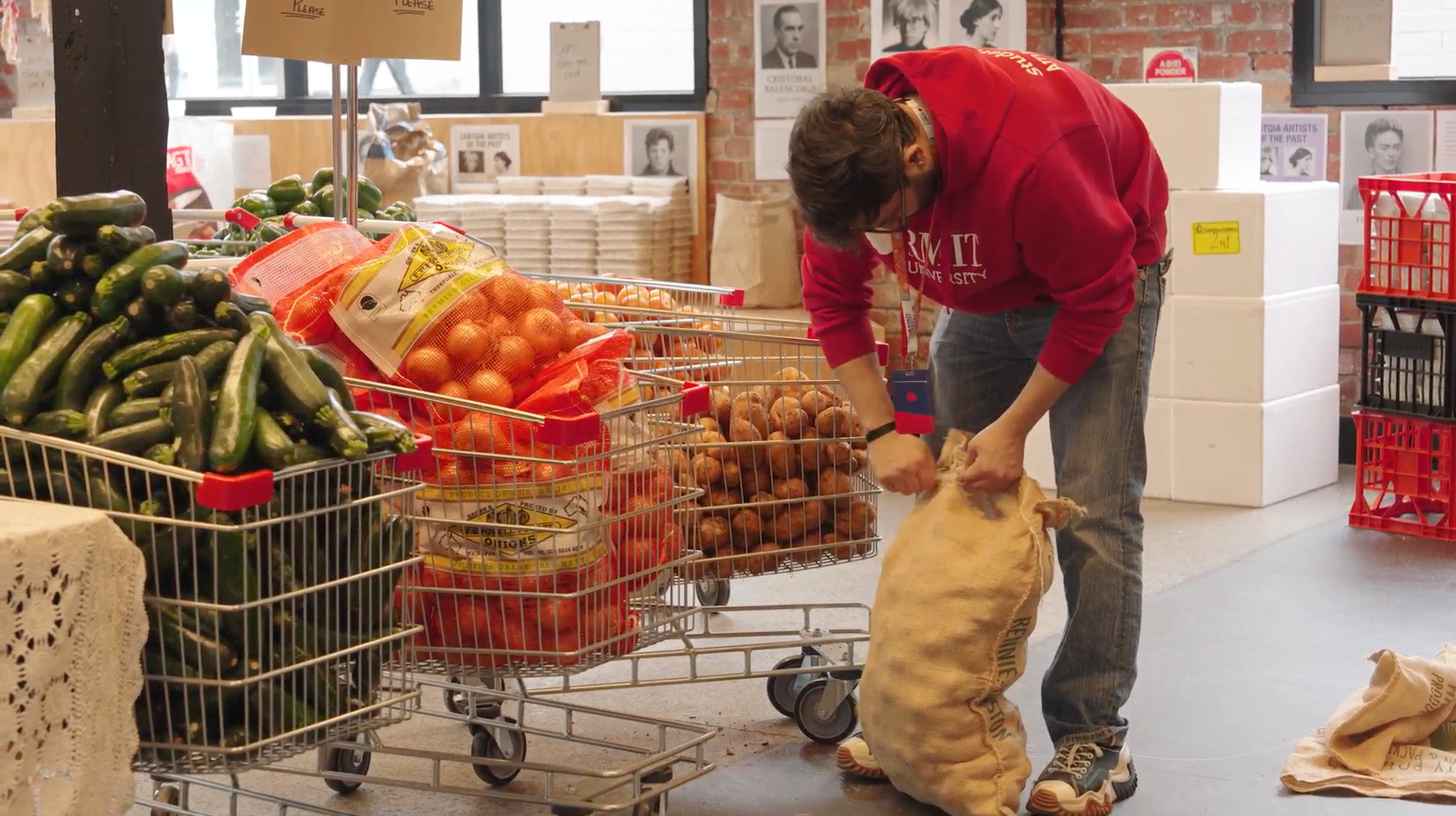
Using areas located within RMIT’s City North Social Innovation Precinct, the RMIT Free Grocer provided students with access to fresh, locally sourced fruits, vegetables, noodles and healthy bulk dry goods. 400 students were served weekly across the Project’s run, and the makings for 16,800 meals were given to students. Around 3,600 lunches/take-home meals were also provided, allowing for 2,100 students to be served overall.
Key Project Activities, Milestones & Deliverables
The City North Student Food Co-Op Project delivered a range of activities aimed at reducing food insecurity for RMIT students. These initiatives combined free and low-cost approaches to strengthen local food systems, supporting ‘seconds’ suppliers and regenerative practices.
Groceries and take-home meals were delivered to 400 students a week. Additionally, visual assets and process documentation were created, and infrastructure was purchased for future grocery activations. A dashboard and extensive cookbook were also created and have been made available to the public.
By the Project’s end, over 20,000 ingredients and take-home meals had been provided to students. Post-project surveys showed 91% of students who accessed the Student Food Co-Op believed it to be worthwhile, and 94% agreed that the initiative made them feel more supported as a student.

Project Impact
The Student Food Co-Op acted as a pilot project based on research conducted in 2024 funded by RMIT’s City North Activation Challenge. The Project was co-designed with Masters students studying system design from RMIT’s School of Design, and produced data relating to university student demographics, frequency of attendance and qualitative experiences.
A key finding from the research was that those at greatest risk of food insecurity are international, postgraduate STEM College students. Males were also found to be marginally more at risk than females, but this was in accordance with general RMIT demographics.
During the Project’s run, multidisciplinary and multi-institutional team collaboration was vital. This helped create a new model of food relief that was low-touch and accessible. As a result, a larger cohort of students could be reached including those that often cannot access current forms of food relief.
An element of The Student Food Co-Op’s that also helped the Project deliver impactful food relief was the venue’s layout. The Grocer offered free to low-cost food via a supermarket style set up which allowed staffing levels to be kept low, and the speed of service to be increased. Even with very few staff members, over 100 students could be served pantry packs and over 200 students given take home meals every hour.
“Our post-project surveys showed 91% of students said going to the grocer was ‘worth their time’.”
Project Leads, Student Food Security Co-Op Project
Future Planning
Plans to present documentation and acquired knowledge gathered during the Student Food Co-Op Project to RMIT’s Student Union (RUSU) is being discussed. These presentations aim to aid RUSU in the expansion of their pantry program in 2026.
The Project’s partnership with Alex Makes Meals has also been set to continue with RUSU in 2026, with the possibility of RUSU transforming the RMIT City Campus’ ‘Realfoods’ site into a canteen and using Alex Makes Meals as a supplier. This collaboration will allow a further iteration of the free and low-cost food distribution model and food education program to come out of the one location.
To make the Project more sustainable and scalable in the future, the development of permanent, dedicated food infrastructure at RMIT University has been recommended. The delivery of the Student Food Co-Op Project highlighted that kitchens, storage, cool rooms and transport are vital pieces of infrastructure that increase both the efficiency and reach of food relief programs.
“[Approximately] 94% of students agreed that the initiative made them feel ‘more supported as a student’.”
Anna McLeod and Dr Helen Addison-Smith, Project Leads — Student Food Security Co-Op
Acknowledgements
Farmers Pick, Alex Makes Meals, Just Food Collective, The Community Grocer.