Reworlding: Cardigan Commons
RMIT College of Design & Social Context — School of Design
Project Lead: Assoc. Prof. Troy Innocent
Project Summary
The Reworlding City North Project responded to the emerging need for cities to explore new ways to inspire community engagement with long-term transformation as climate pressures intensify.
The Project utilised the urban play method to make the concept of regenerative futures tangible. A range of approaches were considered to ascertain how RMIT’s City North Social Innovation Precinct, more specifically, Cardigan Street, could act as a living lab governed by Indigenous values. These approaches were tested and evaluated on the extent to which they could address the challenges the City North District faces, such as its fast-growing population density. The approach selected was live-action role-play (LARP).
Reworlding City North also connected Indigenous language and ecology to exploring regenerative futures in urban environments. This incorporation of multiple knowledge systems proved vital for the Project as it offered ways to live well together in the future in addition to mitigating climate anxiety and offering pathways to collective action.
To establish the Project, RMIT Future Play Lab collaborated with the City of Melbourne, Regen Melbourne, Yalukit Willam Nature Reserve, and Melbourne International Games Week (MIGW).
“People came together to experience City North as a regenerative neighbourhood.”
Assoc. Prof. Troy Innocent, Project Lead
Key Project Activities, Milestones & Deliverables
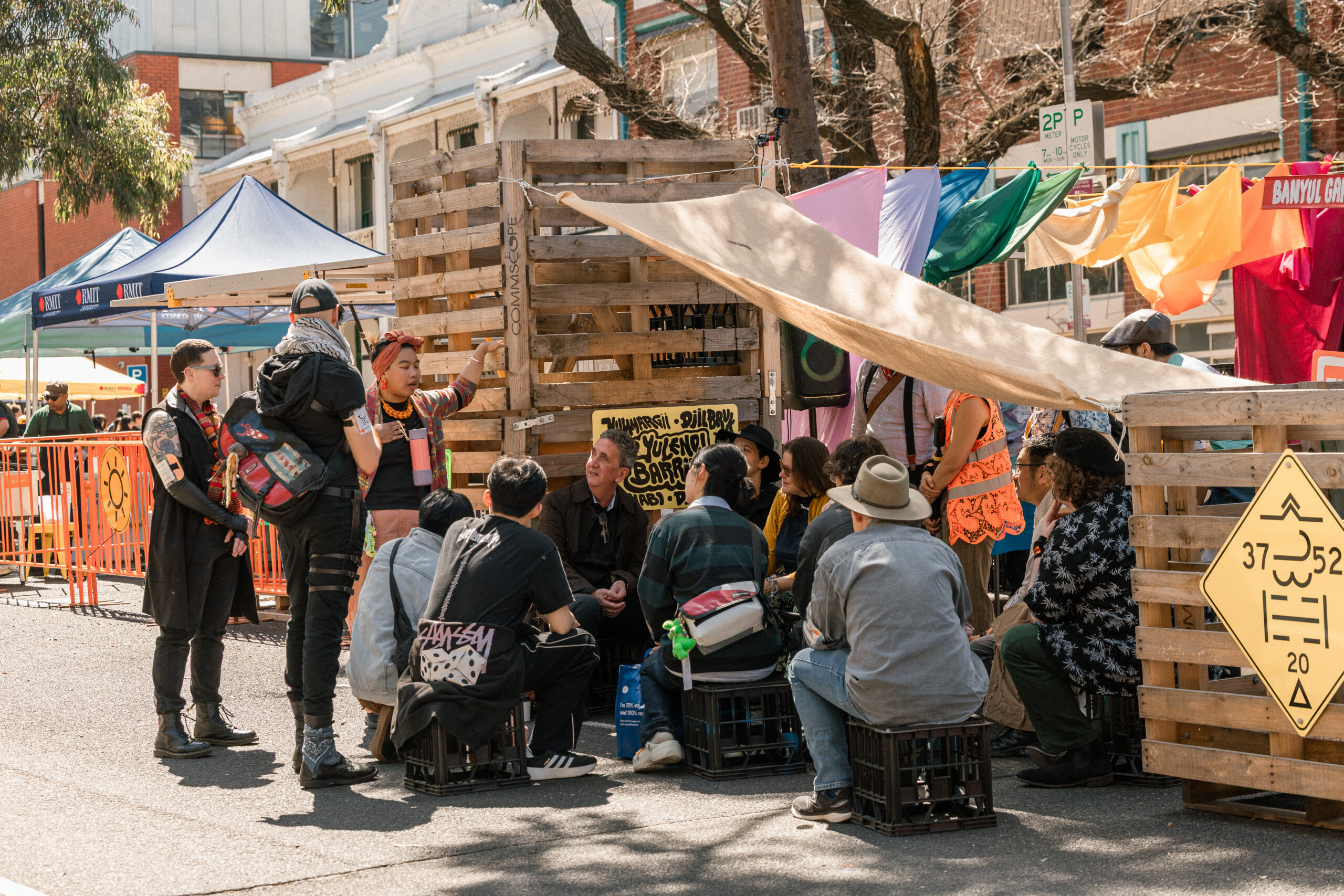
The Project centred on a two-day closure of Cardigan Street as part of the 2025 City North Shared Futures Festival, transforming it into an urban playground and civic commons for learning and engagement. Creatives, academics, artists and industry partners came together
to reimagine the street as a site for public activation.
The event combined three connected components: a shared visioning process for social innovation and regeneration, a live-action role-play (LARP) exploring regenerative futures in Naarm/Melbourne in 2050, and Indigenous language and ecology workshops that positioned the street as a place of learning.
Through the LARP, participants engaged with challenges such as sustainability, equity, climate adaptation and community resilience, supported by Boonwurrung language workshops and guided walks through an ecological streetscape of native species.
Around 30 creatives contributed to the design of the environment, engaging approximately 80 active participants across a diverse cohort of students, professionals, residents and families. More than 3,000 people passed through the site, with many observing and participating in the activation.
The event was structured around two key components. The first component was the 2025 City North Shared Futures Festival — and the transformation of Cardigan Street into a civic square and urban commons for experiential learning and engagement. The second was the use of urban LARP to engage players in imagining Naarm/Melbourne in 2050. Players explored challenges such as sustainability, equity, climate adaptation, and community resilience through collaborative problem-solving and role-play. They were also immersed in Boonwurrung language learning workshops, and walking tours through an ecological streetscape filled with native species.
Project Impact
The Project revealed diverse ways participants experienced engagement with their environment, their communities, and ideas of the future. Reflections highlighted the multidimensional impacts of immersive, playful, and participatory approaches.
The outcomes of the activity aligned with the Project’s overall goals. As immersive play serves as a powerful modality for collective future-building, participants reported a heightened sense of agency, social connections, and increased awareness of complex urban and environmental systems. The playful, participatory format temporarily dissolved social silos, enabling individuals from diverse backgrounds to collaborate creatively and envision shared futures. The event also fostered culturally grounded engagement, and a deeper connection to place.
The Project’s findings have since been published in a report entitled ‘Reworlding as Method; Approaches to Urban Play in the Future Play Lab’ which was then shared at the Smart City Expo World Congress in Barcelona 2025.
“Reworlding City North is a great example of street level regeneration and transformation. Closing down the street to traffic, changing the way we utilise the street, bringing people together — we’re allowing them to walk around, feel, and see the tangibility of what the future might hold.”
Nina Sharpe, Regen Melbourne
Future Planning
Future opportunities to utilise the Project methods would provide greater insight into how they can inform broader civic practice and future-building. By reflecting on how the Project’s use of play facilitated collaboration, problem-solving, and engagement in response to complex social and environmental issues, the potential for participatory, immersive methods that translate individual and micro-level experiences into collective action at the civic level can be understood.
Grant applications to VicHealth and the Australian Research Council to progress the Project with key partners have been submitted, with outcomes pending. Alison Soutar has since developed a PhD project on place-based learning, and a research Community of Practice has been established in RMIT’s School of Design. Plans to engage with the RMIT Place and Community Framework in 2026 have also been made to expand the Project with Open House Melbourne.

“Project participants reported a heightened sense of agency, social connections, and increased awareness of complex urban and environmental systems.”
Assoc. Prof. Troy Innocent, Project Lead — Reworlding: Cardigan Commons
Acknowledgements
City of Melbourne, Regen Melbourne, Yalukit Willam Nature Reserve, Melbourne International Games Week, N’arweet Carolyn Briggs AM, Wendy Steele, Nina Sharpe, Carlo Tolentino, Alison Soutar, Gio Fitzgerald, Ashleigh Dharma.